
Wirekite Replicate
Stream every change. Catch up in minutes.
Wirekite Replicate keeps your warehouse in lockstep with production. Built for teams that can't accept four-hour reporting lag.
The CDC performance problem.
Change Data Capture is supposed to be the fast path between OLTP and analytics. In practice, most teams' CDC pipelines fall behind during peak hours, recover overnight, and run their reporting on eight-hour-old data.
The bottleneck is rarely the source. A busy primary can emit hundreds of thousands of changes a second, and the database hands them over without breaking a sweat. The problem is downstream: most tools parse, transform, and apply those changes one at a time on the target.
Wirekite Replicate captures changes straight from the source and applies them on the target in efficient batches. The loader keeps up with what the source can produce, not with what a typical CDC tool can consume.
How Wirekite Replicate works.
Extract
Capture every change, fast
Wirekite reads changes straight from the database's own change feed, keeping every available channel busy. The source-side bottleneck disappears.
Move
Carry changes with no overhead
Changes move in a compact form built for speed — no bloated intermediate to slow the hot path down.
Load
Apply in batches, keep up
Changes land on the target in efficient batches through its fastest apply path, so the pipeline keeps pace with the source instead of falling behind a row at a time.
Lag, throughput, ordering — all live.
Drill into any table at any moment. The pipeline never goes dark on you.
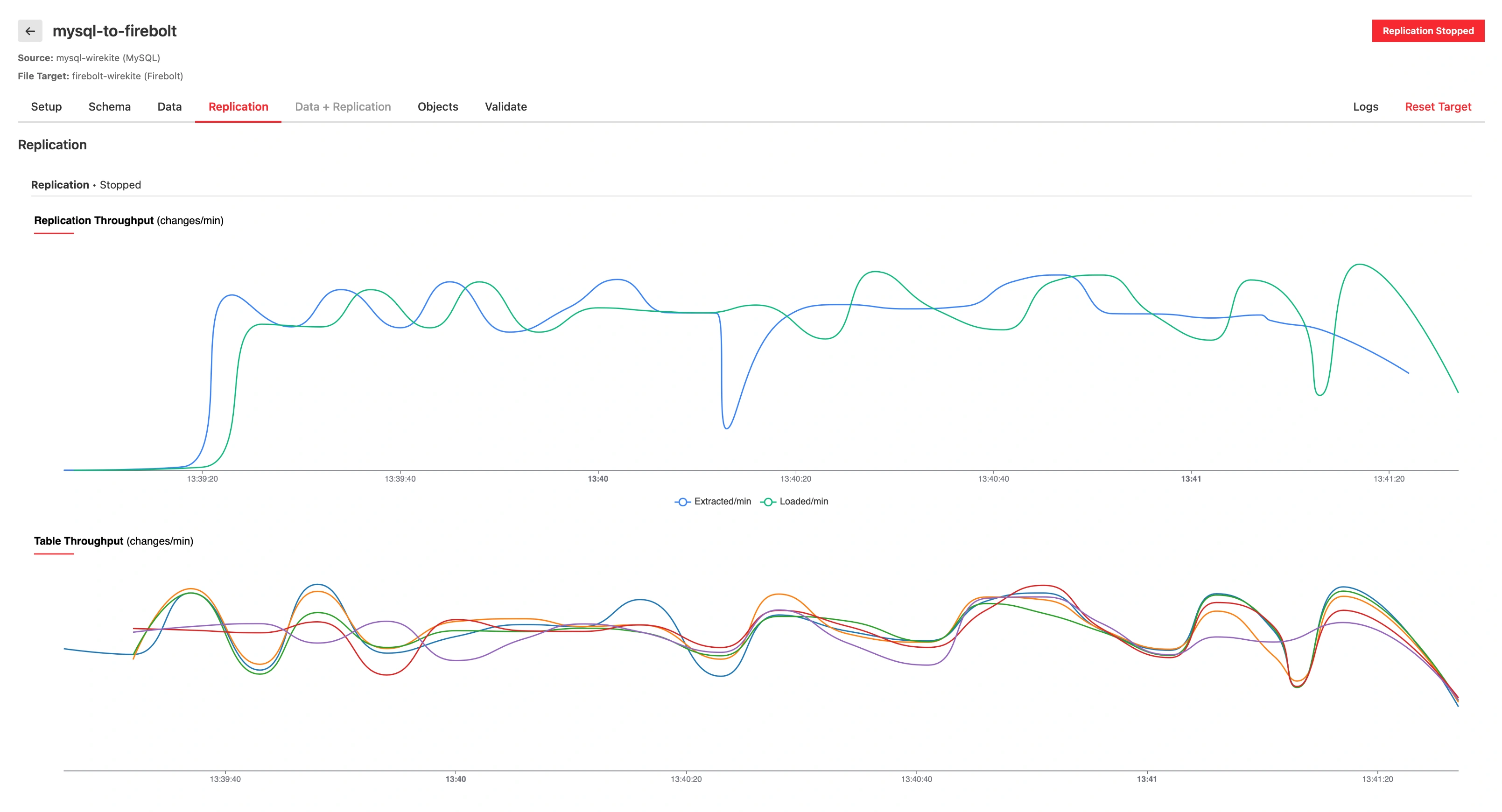
What the numbers look like.
Lag measured under sustained production-shaped load.
Targets beyond databases
Stream changes to Kafka, Redpanda, or Pub/Sub.
Same Replicate pipeline. Per-table ordering. Exactly-once delivery.
Read about queues
Trust the pipeline
Validate the target row by row.
On demand, any time. Type-aware comparison across cross-database edge cases.
Read about validation
Need your warehouse current?
We'll set up a CDC pipeline against your sample workload during the demo.