
Wirekite Validate
Validate every row. Source vs target.
Most migration tools tell you the load succeeded. Wirekite proves it — row by row, column by column, with type-aware comparison across cross-database edge cases.
After a migration completes, the question every operator asks is the same: did all the data actually make it? Most tools answer with a row count. A few add a hash comparison on sampled rows. Neither catches the subtle stuff — a timestamp precision loss, a numeric rounding, a NULL-vs-empty-string slip in the type mapping.
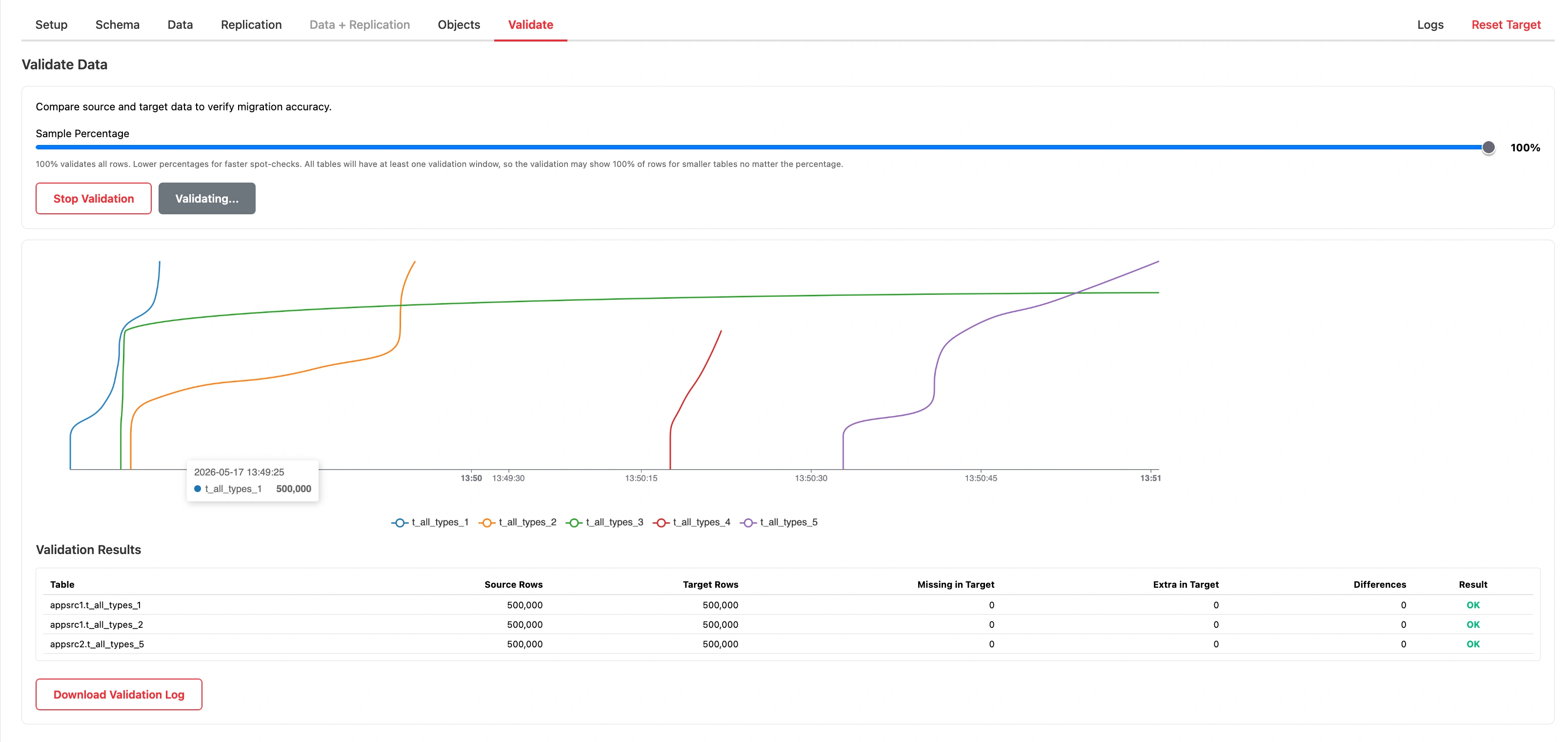
Wirekite Validate walks both source and target result sets in lockstep, sorted by primary key, and compares every column in every row. Discrepancies surface as missing, extra, or value mismatch — with the offending row sampled so you can see exactly what differs.
How it works.
1
Window the table
Wirekite splits each table into windows (default ~100K rows). Sample percentage selects how many windows to validate. Small tables always validate fully — the slider can't skip them.
2
Stream both sides
For each window, Wirekite issues a sorted-by-PK query on the source and the target. The two cursors walk forward in lockstep. No staging, no full table copy — bounded memory regardless of table size.
3
Compare cell by cell
Each row is compared column-by-column with engine-aware logic. Up to 100 diffs per error type are sampled into the report so you can read them, but every row is counted.
Cross-database comparison is hard.
Wirekite knows the gotchas.
A "1.0" in Postgres and a "1" in Snowflake are the same number. Wirekite knows that. Naive comparison thinks they're a diff.
- Numeric precision
- 1.0 vs 1, NUMBER(38) vs BIGNUMERIC — compared as numbers, not as strings.
- Timestamps
- MySQL 3 ms vs Postgres microseconds. Timezone offsets ± HH:MM. Fractional-seconds normalization. 1-second tolerance for MySQL.
- Dates & times
- 2024-01-01 vs 2024-01-01 00:00:00, with microsecond tolerance.
- JSON
- Semantic equality — key order, whitespace, and indentation don't matter.
- NULL handling
- Oracle's empty-string-as-NULL, the opt-in EmptyEqualsNull flag, per-source null-equivalence rules.
- UUIDs & binary
- Case-insensitive UUIDs. Trailing-zero padding for binary / hex between SQL Server and Google Spanner.
- Geometric types
- Postgres point / line / box with engine-side normalization.
- Intervals, XML, money, booleans
- Oracle YEAR-MONTH vs Postgres interval string. XML whitespace. Currency formatting. 0/1 vs false/true.
Why most products stop at row counts.
Validation is expensive. Walking both sides of a migration in lockstep means two full table scans, sorted by PK, with engine-aware comparison for every column type. Most migration tools punt — they verify the row count, maybe a checksum on a few sample rows, and call it done.
Wirekite ships full row-level validation as a first-class feature because we built the engines to make it fast. The same engine that moves data quickly also walks the validation cursors quickly.
A green "OK" on every table means every row matches. Not "the count matches" — every row.
Want to see it on your data?
We'll run a migration on a sample of your workload — and validate every row of the result during the demo.
Book a Demo